 Add to Chrome
 Add to Firefox
 Add to Edge
AutoPPA: Automated Circuit PPA Optimization via Contrastive Code-based Rule Library Learning
Apr 20, 2026
Performance, power, and area (PPA) optimization is a fundamental task in RTL design, requiring a precise understanding of circuit functionality and the relationship between circuit structures and PPA metrics. Recent studies attempt to automate this process using LLMs, but neither feedback-based nor knowledge-based methods are efficient enough, as they either design without any prior knowledge or rely heavily on human-summarized optimization rules. In this paper, we propose AutoPPA, a fully automated PPA optimization framework. The key idea is to automatically generate optimization rules that enhance the search for optimal solutions. To do this, AutoPPA employs an Explore-Evaluate-Induce ($E^2I$) workflow that contrasts and abstracts rules from diverse generated code pairs rather than manually defined prior knowledge, yielding better optimization patterns. To make the abstracted rules more generalizable, AutoPPA employs an adaptive multi-step search framework that adopts the most effective rules for a given circuit. Experiments show that AutoPPA outperforms both the manual optimization and the state-of-the-art methods SymRTLO and RTLRewriter.

RTLSeek: Boosting the LLM-Based RTL Generation with Multi-Stage Diversity-Oriented Reinforcement Learning
Mar 29, 2026Register Transfer Level (RTL) design translates high-level specifications into hardware using HDLs such as Verilog. Although LLM-based RTL generation is promising, the scarcity of functionally verifiable high-quality data limits both accuracy and diversity. Existing post-training typically produces a single HDL implementation per specification, lacking awareness of RTL variations needed for different design goals. We propose RTLSeek, a post-training paradigm that applies rule-based Diversity-Oriented Reinforcement Learning to improve RTL correctness and diversity. Our Diversity-Centric Multi-Objective Reward Scheduling integrates expert knowledge with EDA feedback, and a three-stage framework maximizes the utility of limited data. Experiments on the RTLLM benchmark show that RTLSeek surpasses prior methods, with ablation results confirming that encouraging broader design-space exploration improves RTL quality and achieves the principle of "the more generated, the better results." Implementation framework, including the dataset, source code, and model weights, is shown at https://anonymous.4open.science/r/DAC2026ID71-ACB4/.
CodeV-R1: Reasoning-Enhanced Verilog Generation
May 30, 2025Large language models (LLMs) trained via reinforcement learning with verifiable reward (RLVR) have achieved breakthroughs on tasks with explicit, automatable verification, such as software programming and mathematical problems. Extending RLVR to electronic design automation (EDA), especially automatically generating hardware description languages (HDLs) like Verilog from natural-language (NL) specifications, however, poses three key challenges: the lack of automated and accurate verification environments, the scarcity of high-quality NL-code pairs, and the prohibitive computation cost of RLVR. To this end, we introduce CodeV-R1, an RLVR framework for training Verilog generation LLMs. First, we develop a rule-based testbench generator that performs robust equivalence checking against golden references. Second, we propose a round-trip data synthesis method that pairs open-source Verilog snippets with LLM-generated NL descriptions, verifies code-NL-code consistency via the generated testbench, and filters out inequivalent examples to yield a high-quality dataset. Third, we employ a two-stage "distill-then-RL" training pipeline: distillation for the cold start of reasoning abilities, followed by adaptive DAPO, our novel RLVR algorithm that can reduce training cost by adaptively adjusting sampling rate. The resulting model, CodeV-R1-7B, achieves 68.6% and 72.9% pass@1 on VerilogEval v2 and RTLLM v1.1, respectively, surpassing prior state-of-the-art by 12~20%, while matching or even exceeding the performance of 671B DeepSeek-R1. We will release our model, training pipeline, and dataset to facilitate research in EDA and LLM communities.
TensorTEE: Unifying Heterogeneous TEE Granularity for Efficient Secure Collaborative Tensor Computing
Jul 12, 2024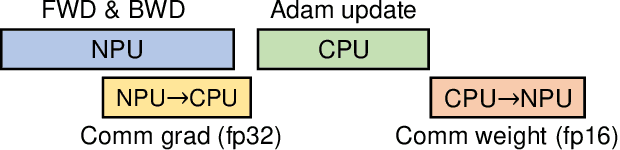
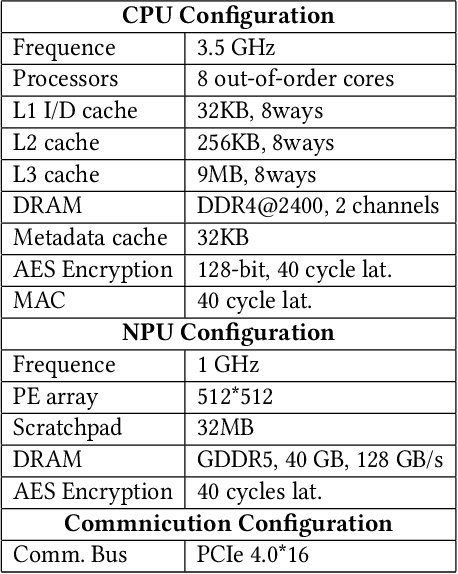
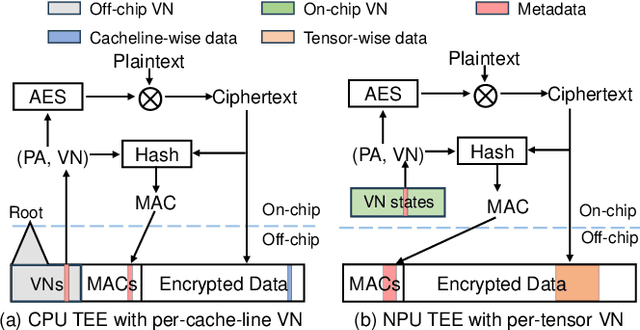
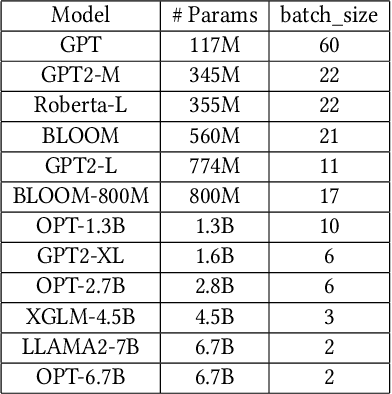
Heterogeneous collaborative computing with NPU and CPU has received widespread attention due to its substantial performance benefits. To ensure data confidentiality and integrity during computing, Trusted Execution Environments (TEE) is considered a promising solution because of its comparatively lower overhead. However, existing heterogeneous TEE designs are inefficient for collaborative computing due to fine and different memory granularities between CPU and NPU. 1) The cacheline granularity of CPU TEE intensifies memory pressure due to its extra memory access, and 2) the cacheline granularity MAC of NPU escalates the pressure on the limited memory storage. 3) Data transfer across heterogeneous enclaves relies on the transit of non-secure regions, resulting in cumbersome re-encryption and scheduling. To address these issues, we propose TensorTEE, a unified tensor-granularity heterogeneous TEE for efficient secure collaborative tensor computing. First, we virtually support tensor granularity in CPU TEE to eliminate the off-chip metadata access by detecting and maintaining tensor structures on-chip. Second, we propose tensor-granularity MAC management with predictive execution to avoid computational stalls while eliminating off-chip MAC storage and access. Moreover, based on the unified granularity, we enable direct data transfer without re-encryption and scheduling dilemmas. Our evaluation is built on enhanced Gem5 and a cycle-accurate NPU simulator. The results show that TensorTEE improves the performance of Large Language Model (LLM) training workloads by 4.0x compared to existing work and incurs only 2.1% overhead compared to non-secure training, offering a practical security assurance for LLM training.